
This story contains spoilers, some of them major, for Industry seasons one through four.
It’s not uncommon for a television show to get better over time, but rarely does a show get exponentially better season over season. This is what has happened to HBO’s Industry, which began its life in 2020 as a show you might watch if Succession didn’t slake your thirst for cutthroat office politics and random yelling of Business Numbers, and is now simply one of the best television shows of the decade. What was once a nervy, sexy peek into the lives of attractive and slightly insane young investment bankers in London has become, in season four, an expansive carnival of capitalism’s nastiest components: market manipulation, corporate espionage, journalistic malpractice, political chicanery, and a steady flow of money that funds vices both cheeky (a few too many cocktails at the members-only club) and depraved (underage escorts used for blackmail purposes). The devil is real, and he’s wearing a fleece vest with a corporate logo embroidered on the left breast pocket.
Critical to Industry’s excellence is its soundtrack, helmed by music supervisor Ollie White, whose selections throughout the show’s run have been both an extra layer of storytelling nuance and a collection of heaters you could easily port from the Pierpoint trading floor to an East London nightclub. With composer Nathan Micay’s arpeggiated synth score as a lush base, White has pulled lots of music from the 1980s: Talking Heads accompanying shady biz deals, post-demotion dissociation set to Public Image Ltd., Simple Minds and Pet Shop Boys blaring on a lethal yacht trip. Still, there’s plenty of opportunity for eclectic choices, from trap music for uncomfortable strip club outings (“Ooo” by IMDDB) to ‘60s garage rock for hallucinations of deceased aristocratic dads (the Electric Prunes’ “I Had Too Much To Dream (Last Night)") to a surprising amount of Christmas music (even in the streaming era, the time-honored “Christmas episode” tradition is not dead—not if British people have anything to say about it). And Industry’s party scenes are some of the most entertaining I’ve ever seen, with plenty of tasty remixes at the club—that’s the classic Tiësto trance version of “Silence” playing during Kit Harington’s don’t-mind-if-I-do moment with a glory hole this season—and excellent U.K. electronic artists like Bicep and Elderbrook soundtracking the afters.
We chatted with Ollie White about the stories behind season four’s most legendary syncs (including that gorgeous Daft Punk moment ), how Industry’s music supervision has changed over time, and why ‘80s music pairs so well with social climbing. After that, check out our picks for Industry’s best-ever needle drops.
Ollie White: I’m having heart palpitations [watching the show]. There’s a lot of scenes that I’ve watched millions and millions of times, but I’m still stressed. When we first got the scripts, reading through them—it was such a level up from season three. And then you see the acting and the performances and all the rushes, and honestly, I’m just like, Oh, how the heck am I just gonna get up to that level?
[Composer] Nathan Micay and I, we’re just in awe of all of them. So it really pushes us. It’s a great motivator to try to get as close to that level as possible. And hopefully we do.
Yeah, it does. Obviously, with season four, the budgets get bigger, which massively helps with a lot of the needle drops. We are using songs that we would never have ever been able to afford in previous seasons. But you have to do that, because when you’ve got the level up in the story and the level up in the cinematography, the costumes, et cetera., you’re setting this bar that you have to meet with the music as well.
There are a lot of standalone episodes, which we didn’t have in previous seasons, which was really fun musically. Episode two, we basically were told, “This is Barry Lyndon. It’s a period drama. Let’s stray a little bit away from what’s typical for Industry and go mad with it.” So we used a lot of music that we probably would never have used. Because that was so early on in the season, it allowed us to be more adventurous, and take what we’d done from that episode and sprinkle it into the latter episodes as well.
So I had to pitch for the TV show, which is very typical for music supervisors, but particularly because I’d never done a TV show before. I’d done a lot of fashion ads within London. And I read the scripts and had become good mates with Mickey [Down] and Konrad [Kay] from DJing out in the London nightlife scene. The big idea with season one was that a lot of it is set on the trading floor, which is very sterile, cold, bleak. But these characters have worked their asses off to be there, and actually are really excited about this first opportunity of working in finance. And we wanted to capture that in a relatable way for most people.
So it was, “Let’s turn the trading floor into a dance floor.” And if you were to watch the first few cuts of episode one, it was dance anthems on the trading floor. It was really fun, but dialogue got lost, and things like that. So we were like, Okay, this is what we want to feel, but how can we, practically, make this work? And we hired Nathan Micay because we loved his music. He’s an amazing DJ, and he could bring that energy of the dance floor in a sensible way that works for TV drama—removing the drums, having those rhythms on arpeggios, synths and basslines.
Also, this was a TV show [set] in London, and we wanted to capture the sound of London at the time: electronic music was on the rise, house music, Bicep kicking off, and then the grime side of things as well. Moody, cinematic electronica and hip hop were a big driver for us, and we still try to tap into that even now, even when the characters are a lot older.
Exactly. There is a version [of the show] which has got DJ mixes— I was literally doing DJ mixes in the background, which is probably going to end up on the internet at some point.
Probably the one that a lot of people wouldn’t get, and we use it a lot through season three and season four, is "For He’s An Englishman." Which is from an opera by Gilbert and Sullivan, [H.M.S. Pinafore]—a very famous English opera here in England, but no one outside of England knows about it. We’ve had Henry singing it, we’ve had Yasmin’s dad singing it, we’ve had Otto singing it. It comes back in its various forms. And the whole idea of that is that we’re taking the piss out of the class system in the UK. It’s this very snarly, witty song, and it basically means that, Well, I’m an Englishman. I can get away with anything. There’s no consequences for me. Which is a lot of what Industry is about—particularly Henry’s storyline now, because he has done some horrific things. And at the really upper echelons of society in the U.K. system, you can do something and you kind of get away with it. And that song’s very much a mockery of that.
We play on nostalgia a lot too. With season one, we were conscious that we may have alienated the older generation, because it was a very contemporary storyline, with very contemporary music. We wanted to open paths for the older viewers to get into it, and we wanted to use music as a gateway for that nostalgia: Oh, I remember being out clubbing when this played. And also eighties music is awesome, and the remixes of ‘80s music brings it into the current day.
New Order was a big driver for me. I’d say they’re my favorite band, ever. The link to the eighties, a lot of it stemmed from our score—Nathan uses a lot of eighties synth sounds. We’ve used a lot of contemporary synth music, but there’s something about the way that the eighties sound and has this sort of timeless quality to it. Which, particularly in the last two seasons where the point of view of the story has social-climbed a bit—season one, we were at the bottom, and now we’re often in settings and environments and with characters that I, or most people are never, ever going to be around. And there’s an unattainable level to that, and I feel that, in order to be able to warrant that unattainable level, the music needs [to have] a timelessness to make you feel worthy. There’s something grand here.
Depeche Mode, I need to get in there. We haven’t got them in yet. Next season.

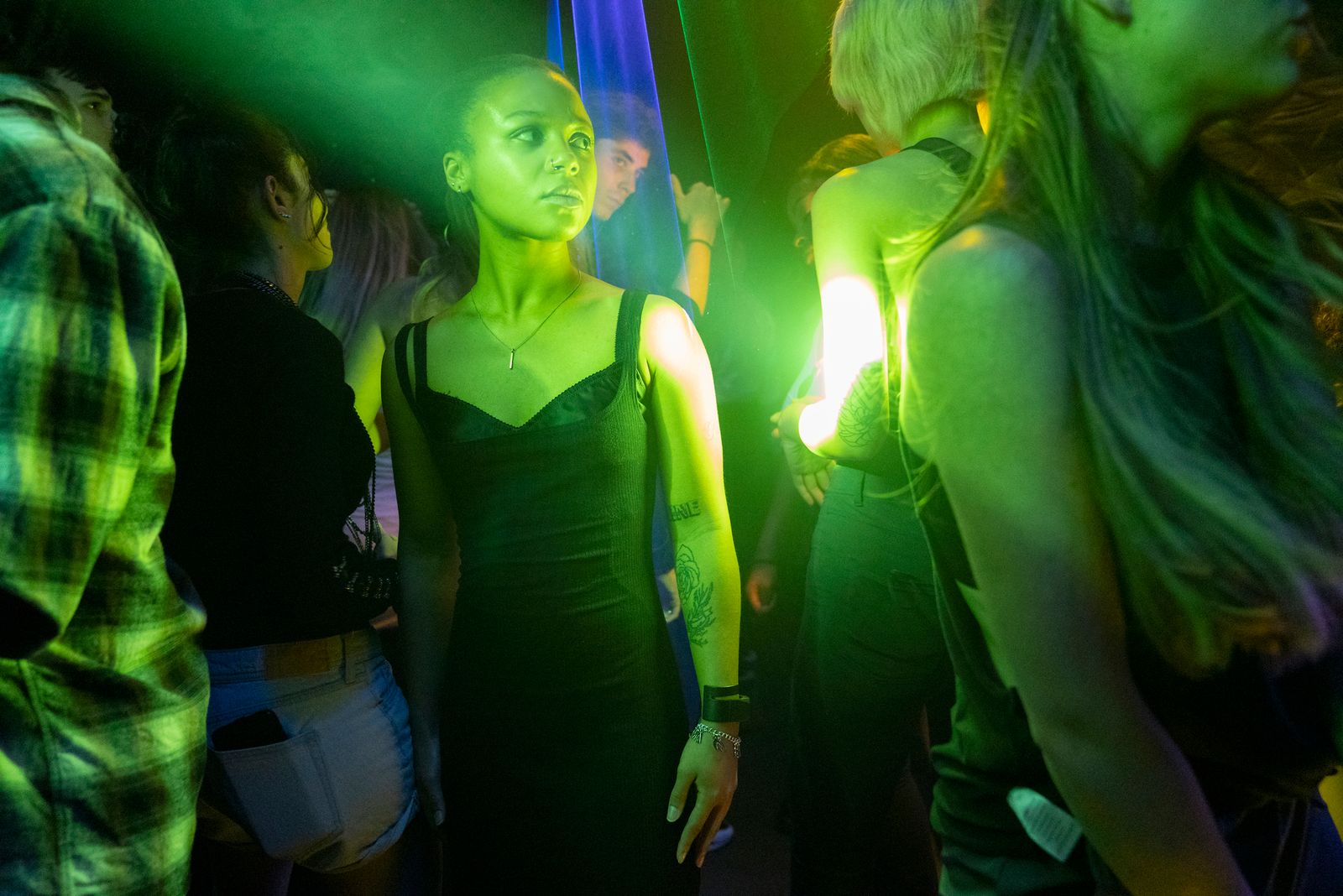
I think episode four of this season, Rishi’s afterparty, captures a lot of that. I would say Paris Angels’ “All On You (Perfume)” is one of the best party songs ever. I’ve DJed that all the time. If you ever find me at the afters, that is what I’m going to be putting on. And then I would say that whilst Ultravox’s “Vienna” is one of my favorite songs ever, it’s not something you play a party for exactly the reasons that we see there. It’s way too emotional, and way too jarring, and someone’s going to have a bad trip on that. But yeah, party music is really the DNA of Industry’s sound. Mickey and Konrad love partying—I’m actually DJing with Mickey on Friday at Tramp. It’s his birthday party. We just get up and play songs that we like, and probably will license for the next season [laughs].
It was. That was something that we would never have ever been able to afford. It was very, very expensive. And we had to sacrifice a few cues that were really hard to to lose in order to get the budget for that. But it’s such an amazing moment. That was something that Mickey and Konrad put in the script from the very early stage, so we knew we were going to use that song ages ago. It took an eternity to clear it!
It’s such a recognizable tune. It’s so emotionally powerful. I think it kind of sums up what we try and do with dance music. We want a song that has muscle, but also rips your heart out at the same time. I feel like that Daft Punk song does that perfectly. It’s so beautiful, the way that it develops. I think we really lean into melancholy with Industry music—that fine line of where melancholy and hope meet. I feel like a lot of the characters are quite sad and melancholic and reflective on the past, but there’s still hope for what they want. They always think the grass is greener. It’s a sweet spot for us.
Industry’s Best Needle Drops
I knew this show was going to be a taste-driven affair when neophyte trader Harper starts masturbating on a video call in order to get her ex-boyfriend to forge a college transcript for her, to the tune of this minimalist ‘80s-by-way-of-2010s banger from Dev Hynes. Mixing business with pleasure is a feature in Industry, not a bug. “Dinner” works well as alluring audio for lightly transactional cybersex, and it’s got the lyrics to match: “Breaking out of this cocoon and clawing at the camera.”
A hallmark of season 1 is the almighty sesh. The Pierpoint grads who don’t yet have access to the corporate card for bottle service make do with benders at home, which, as office goofus Greg articulately describes them, are “as big a cultural touchstone as, I guess, anything.” The show’s electronic music is always on the correct side of the chic/corny divide, and this 2018 house track from a trio of three English DJs brings megaclub energy into a flat riddled with empty bottles and deflated balloons. What, you’ve never made significant eye contact with your office crush while sucking the hell out of a whippet?
If there’s a signature Industry emotional cocktail, it’s a combination of sweetness and sloppiness, with a base layer of abject melancholy. When Yasmin Kara-Hanani’s gooberish boyfriend Sebastian attempts to throw an elegant dinner for Yasmin’s Pierpoint peers, mortifyingly charging everyone for the privilege, Yasmin blows off steam—and tramples on the supper club’s formality—by showing up in sweaty athleisure and dancing with Harper to an electro grime song from her youth. “This was my fucking jam at Francis Holland!” she slurs, name-checking a day school with a £30,000 annual tuition. There’s something beautiful about the sight of Yasmin wearing a track jacket and dropping it disrespectfully low amid a gaggle of finance people in black tie.
The grads have survived RIF day, careers are kicking off in unexpected ways, and Harper and Yasmin’s paths begin to split. Yasmin, for whom short-term pleasure always seems to trump long-term planning, snorts lines and flirts with Celeste at a house party, unaware of her status as a Pierpoint private wealth manager. Meanwhile, Harper stalks potential mega-client Jesse Bloom with the intensity of a big game hunter, even following him into their hotel swimming pool. The trance-y Elderbrook track highlights how Harper finds corporate gamesmanship just as enjoyable as Yasmin finds her cosmopolitan lifestyle. Side note: Is it British culture to actually dance at house parties? Am I just going to the wrong ones?
After Harper secures a last-minute investment from Bloom that sends Eric’s star client Felim to the back of the sales queue, Micay’s nerve-jangling synths give way to a triumphantly funky Donna Summer song from 1982. A cover of a Jon Anderson and Vangelis song from the previous year, Summer’s version has a secretly stacked choir (Michael Jackson, Lionel Richie, and Stevie Wonder are all on it) and features rhythmic syllables—shablimidi, shablamida—that seem like some sort of ancient religious chant, but really don’t have any meaning in particular beyond sounding kinda neat. It’s the perfect celebratory track for the most harrowing phone call I have ever seen, as well as a neat representation of Harper’s deranged but undeniably profitable trading flow state.
One of the most interesting characters of the series is Ken Leung’s Eric Tao, who begins his journey as a run-of-the-mill aggressive boss, and ends up being a deeply tragic and deeply repulsive figure whose Business Mindset transactionalizes, and therefore poisons, every aspect of his life. His relationship with Felim fully trashed, Eric gets business-dumped at breakfast; Felim’s parting words are oddly prescient: “Without results, Eric, all we’re really left with is your character. And what the fuck is that even, really?” A handheld camera backs shakily away from a demoralized Eric, and Talking Heads’ sweetest love song takes on a sinister edge.
Every so often, someone will show up on the r/jamiexx subreddit saying they love the song “Gosh,” and asking if there are other songs similar to it that they might listen to. And the answer is always, basically, “No.” Over a decade after its release, Jamie xx’s most iconic single is still in a class of its own, and having it show up on the Industry soundtrack felt both inevitable and extremely awesome.
GZA, “Liquid Swords” (Season 2, episode 7)
Ah, Jesse Bloom. A guy whose office is a grand, multi-chandeliered ballroom containing the world’s largest monitor setup, a basketball hoop, and nothing else. (“Got the woman who did George Soros’ house. She asked me if I had any opinions of my own. Harrowing question.”) A billionaire wearing a t-shirt that says “OF COURSE I CUM FAST…I GOT FISH TO CATCH.” And a relative outsider in the financial world, which perhaps explains his affinity for the spiritual leader of the Staten Island-based Wu-Tang Clan. Money, like GZA’s rhyme thoughts, travels at a tremendous speed.
The music supervision on this show has always been cooking with gas, but season three is when we get the full Sunday roast with Yorkshire pudding and all the sauces. You could maybe argue the deployment of this song in a scene of a woman getting photographed might be a little too on the nose…but it’s too good not to use. Especially in this situation, when Yasmin, whose father’s disappearance has left her vulnerable to the ruthless British tabloid machine, realizes anyone with a phone can be paparazzi if they believe in themselves. Can’t a girl just chill out, ride the double-decker bus and drink wine that’s so nice it’s not technically supposed to be drunk?
“White Mischief,” the season-three episode that centers Pierpoint market maker Rishi Ramdani, is an outstanding hour of television, especially if gnawing on your fists in an extended fit of anxiety is one of your hobbies. The song in the background of Rishi’s spree of degeneracy is a tweaked-out rap rock rager from the Atlanta band Algiers, with discordant tones that blare like alarm bells as Rishi gambles, then re-gambles cash that isn’t really his to mess around with. All of the music in this episode deserves a shout, though, from Ramsey Lewis’s cathartic “Les Fleur” (which soundtracks Rishi smashing up his local cricket pavilion) to “Snow Snow Snow” (playing as he dabbles in some festive Christmastime cocaine.)
Industry knows that the comedown is sometimes more important than the party. UK electronic darling Fred Again’s signature vocal stutters meld with Brian Eno’s atmospheric soundscapes to create an otherworldly mood while Robert and Yasmin debrief after their respective Big Nights Out. Robert is processing an ayahuasca trip, and Yasmin is processing “about 8 Negronis” from a member’s club of which she is not a member. It’s a beautiful moment that ends with a revelation: “I guess it doesn’t really matter where the money comes from.” “I think it does. I think I’m finally beginning to see that.”
There are snippets of Yasmin’s argument with her horrid dad all through the season, and “Nikki Beach, Or: So Many Ways To Lose” finally gives us the full story. After a brutal confrontation that involves Charles Hanani splashing a glass of red wine in his daughter’s face and calling her both “talentless” and “a fucking whore,” he jumps off the boat; Yasmin lets him drown, and Harper helps her hide the evidence and put on a brave face. The background music to this pivotal scene is a pair of early 1990s dance tracks that make for great sleazy European boat party music, and whose perkiness offsets the cruelty at hand. The sound design, which has Yasmin and Charles screaming epithets while the music blasts from below deck, amplifies the disjointed mood. And the lyrics are on the nose: “I’ve been getting away with it / All my life.”
Season four kicks off in proper style with an elegant blend of two British dance tracks—one stately and sentimental, the other twitchy and insane. Like Terry’s Chocolate Orange, these are two great tastes that taste great together. It’s also quite a flex that that Industry can open a new season with an extended montage featuring characters we haven’t met yet—journalist James Dycker, and executive assistant Hayley Clay—and barely any dialogue, and still have us 100% locked in. It helps that the music is that good!
After his debacle of a 40th birthday party, Sir Henry Muck comes back from the brink, ditching his plan for suicide-by-vintage-Jaguar and re-consummating his marriage with Yasmin on the hood of the car as “Can’t Take My Eyes Off Of You” by Andy Williams plays. Their post-coital countryside joyride, set to the Pet Shop Boys U2 cover that sneaks in a bit of the Andy Williams refrain, is both exhilarating and unsettling.
This season doesn’t back away from what the content-descriptor listings like to call “strong sexual content,” which is how we get a tense threesome with Henry, Yasmin and Hayley in an Austrian manor house set to a moody synth-pop track from 2015. This is where I get to say that this isn’t the first incredible needle drop for “Bassically”—it was featured in the 2016 smartphone-themed thriller Nerve, starring Emma Roberts and Dave Franco, and I’m using this opportunity to tell everyone that you are 100% sleeping on Nerve, and if you haven’t watched it, you really should.
Rishi’s days of massive trades and breakneck banter on the Pierpont floor are long gone by Season 4; he’s selling cocaine, signing away his son’s last name in exchange for visitation rights, and stalking James Dycker, which is how he ends up at one of the grimmest afters ever depicted on TV. The sound design in this scene replicates with pinpoint accuracy the claustrophobic feeling of a bad party gone on way too long: Dycker rants about the state of the world (“It’s bread and circuses, man, streamed in glorious 4K”) in jerky jump cuts, Rishi dissociates into a reverie about his wife’s murder, and this emotional British chart-topper from 1981 plays, wobbly with reverb, on a stereo system turned up way too loud—before the cops come knocking and one of Industry’s gnarliest moments ensues.
Has anything summed up the heart of Industry like “Veridis Quo”? A faux-baroque synth epic that sounds like it could have been dance music for the court of King George I, this track from Daft Punk’s Discovery plays as Harper and Yasmin put aside their shared history of deceptions and betrayals to, as Yasmin puts it, “just blow things away a bit, you know?” Throughout the series, there’s an ongoing pattern of boom and bust, tension and release, as companies rise and fall and alliances shift and double back again; there’s something beautiful about the main characters’ ability to get out of their heads and live in the moment, no matter how dire the forecast is. In the real world, Yas and Harper are up their ears in Tender drama, but—as they blast cigs in the club’s smoking zone—they’ve ascended to a higher plane of existence. “We’re here forever, even if we can’t be,” Yasmin says. The melody fades out, but the bass booms like a comforting heartbeat, on and on.