
For all its lavish displays of wealth and juicy insider glimpses, the day-to-day world of HBO’s financial thriller Industry leaves little to be desired: Your colleagues and work spouses may betray you for a tip or connection. You may meet an untimely demise from Adderall abuse (at best), or catch a stray from a loan shark coming to collect on your husband’s gambling debt. Or you may learn that getting rich means getting comfortable with some pretty mortifying truths. Nothing about the series—whose season-four finale airs this Sunday—particularly makes one long for a career in stock trading or personal-wealth management. That is, unless you’d more or less do anything in exchange for wearing some truly exceptional suits.
According to Industry’s costume designer Laura K. Smith, there is a nuanced strategy behind dressing London’s (fictional) emerging and established financial figures. If you, too, are a keen adapter of British power dynamics like the show’s American protagonist, Harper Stern (Myha’la), perhaps you’ll graduate from off-the-rack two-pieces to bespoke, Savile Row-made suits. If you haven’t inherited the right watch, you’ll buy it. But, as Harper has observed through her colleagues’ missteps, even if you have the right net worth and wear all the right stuff, you may never truly blend into British high society.
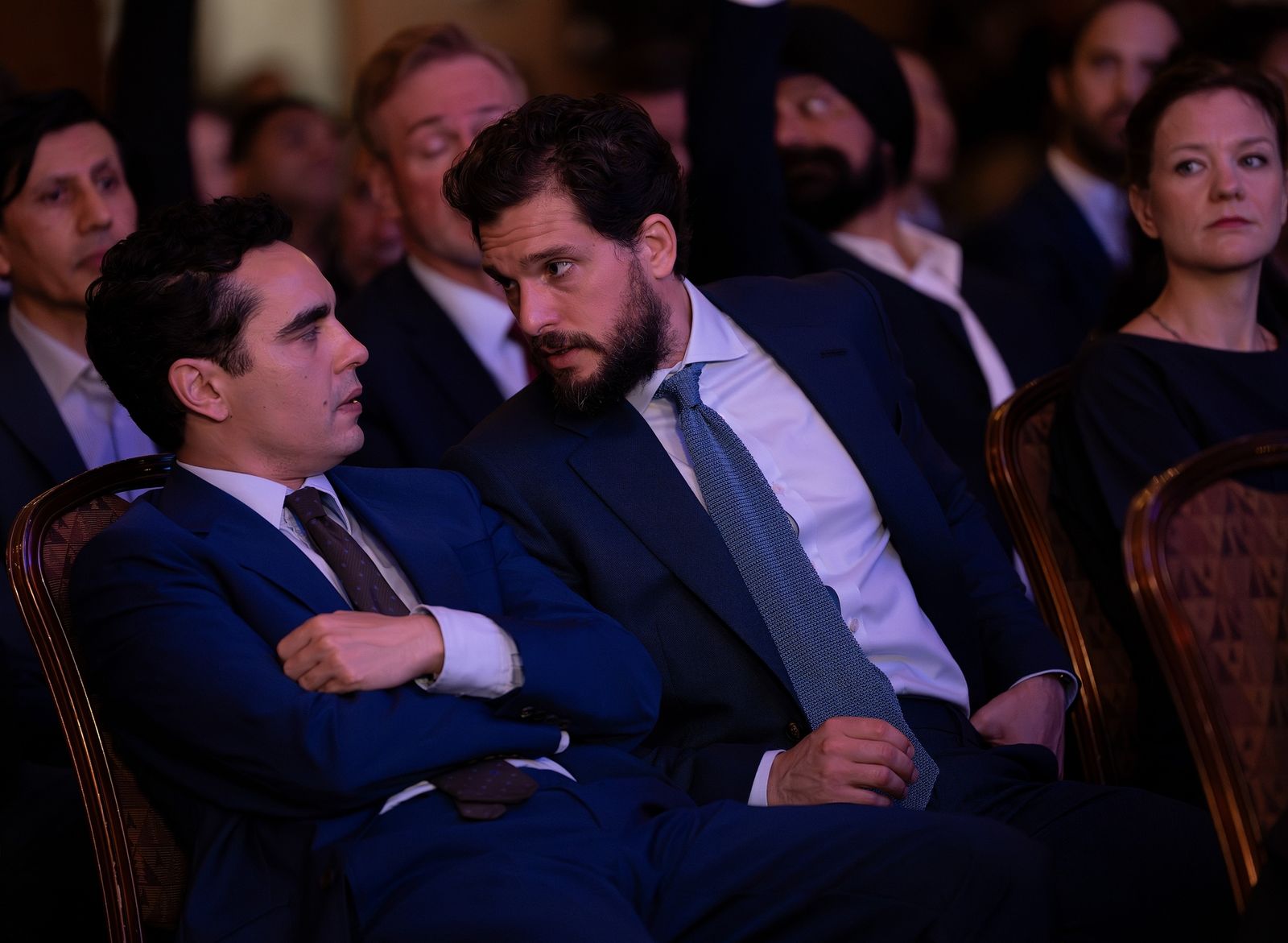
“It’s a kind of code that you have to understand and live and get into your bones,” Smith tells me over Zoom. Consider Whitney Halberstram, CFO of the fictional payment processing platform Tender who’s played by Max Minghella, compared to Sir Henry Muck, member of the British nobility, portrayed by Kit Harrington. “When we first see Whitney, everything that he’s wearing is new for a country weekend. It’s not something he’s experienced that well. He’s obeying all the elements of it, but everything he’s wearing is new, whereas everything that Henry has is much older.”
It’s tricky work. Smith employs all sorts of unusual muses and sneaky Easter eggs to further the show’s narrative, from Hieronymus Bosch’s Garden of Earthly Delights and the Medici’s patronage of the arts, to Donna Karan’s 1980s “Seven Easy Pieces” capsule collection and the culture of having a “block” (a personalized pattern) with a Savile Row tailor. Here’s what went into dressing London’s most cutthroat financiers.
Laura K. Smith: I’m in my studio, it’s in my house. I love having it. I’ve got all my favorite books and everything with me.
I used lots of books as reference for Industry. For season three, I had a book of Renaissance paintings and bought [one] on the painter of the Garden of Earthly Delights, Hieronymus Bosch. I’ve got an amazing book about Georgian diamonds, which I looked at for episode two. It’s never not useful.
It was what Mickey [Down] and Konrad [Kay, creators of Industry] had written in the script about the party on the boat. They said it was like the Garden of Earthly Delights. It had that feeling, all the bodies. Thematically, it just felt really perfect for the broiling world of Industry and that hasn’t gone away.
That painting was a triptych, which a lot of people didn’t realize then. It looks like it’s not very colorful on the outside. It’s quite modest. When it opens, there’s this world of wonder inside. When you look at every little detail, it’s deeply sexual. There are all sorts of weird contorted bodies and ideas of sin, luxuriating in greed and lust. A lot of those paintings were created for bankers, merchants in the Renaissance period. So, it also felt appropriate because there were ways of absolving yourself of sin by investing in godly gifts that you put out into the community, let them read it, and then contemplate what a great person it is that’s created this incredible work. When you think of a world that was at a poverty of pictures, this is a place where they could be glad of what the banker could give them. That was something that felt really interesting. And, anyway, that was the inspiration for Eric’s cuff links, for example.
They were a scripted part of the Pierpoint merchandise Mickey and Konrad wrote in for Eric’s creation as Pierpoint partner. We treated that as original apex merchandise and then had fun creating a range of merchandise to work within the hierarchy of Pierpoint. They were designed to look like a practical agricultural implement that Pierpoint was founded on, but in reality they’re as lethal-looking as a Renaissance-era stiletto blade.
Having cufflinks creates a whole separate discussion in styling and dressing the characters. They are quite showy and we [often] asked: Does that fit with the character? After leaving Pierpoint, Eric wears single cuffs with cufflink closure shirts. It’s practical. It’s easy to take out and roll his sleeves up—he can choose how he presents. Whitney goes between double- and single-cuff shirts from Budd depending on who he is meeting. In contrast, this is something Henry does not do. We played with a rule about Henry really trying to avoid wearing closed collars and suits unless the situation demands it.
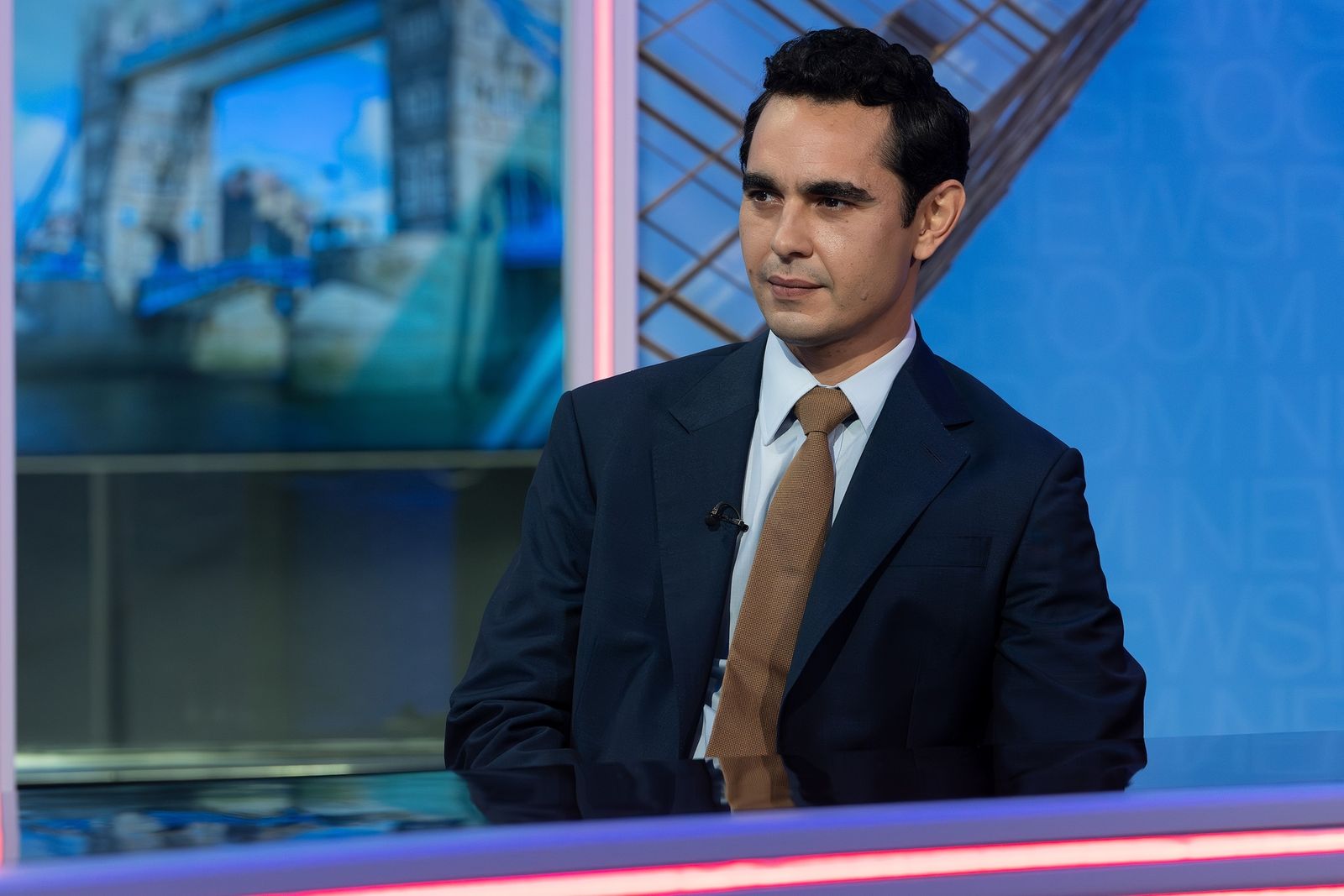
With Whitney, it was about creating something that was understated, but very much blended into the world that he was trying to be part of. There’s a permeableness between politics and tech companies and their boards. We looked at clothes that would allow Whitney to move between political spaces, where he wants to be, and in the boardroom of his bank, Tender, while making him appear indistinguishable from the other tech people. At the same time, he is in a position of authority, so we wanted beautifully tailored suits.
His closet is a mixture of established Savile Row tailoring and then some established American brands. We worked with Richard James, they were really great. All of his suiting was from Richard James. We also worked with Todd Snyder, which felt right for him, too. His shoes were Prada and Crockett & Jones. We worked with very specific colors that worked in a political sphere in particular, because it was about creating a sense of trust, and a sense of establishment in his clothes. That’s why we went into the blues, and very classic but understatedly stylish single-breasted suiting. Some of the fabrics had a two-tone quality in some lights—that kind of changeability felt like it was right for Whitney. He is someone that’s trying to, in some situations, be able to disappear and, in other situations, appear to be in a position of authority.

With Eric Tao, it was about creating a look that, if someone from Pierpoint met him, he would appear to have made it. If [Pierpoint managing director] Hilary Wyndham met him in the street—particularly in the private-wealth-management areas, like Mayfair in London—they would recognize that he’s wearing the right clothes. It’s appropriate to the space that he’s in. The Chesterfield collared coat, the velvet collared coat, the single-breasted—it’s a covert coat, which is very right for somebody like Eric is aspiring to be. It’s a very Saville Row, English sartorial choice to have that type of jacket.
For the suiting we went to Richard Anderson, another Savile Row tailor. Paul Smith, as well, felt like a very desirable suit in the world of Eric’s background, too. There’s always something quite playful in Paul Smith’s tailoring, which felt like it might appeal to Eric in his single-man, divorced-dad status. I try to choose places that feel natural based on what I’ve read of their character, how I’ve talked about the clothes with the actors, and where you imagine they would naturally go.
Well, Henry Muck’s an interesting character because, in London, you meet Henry Mucks. You’ll hear them, and then you’ll see them. [Laughs.] There’s a look. I read an autobiography about Alan Clark, a conservative member of Parliament who was very famous in the 1980s, and he said something very rude about another conservative MP called Michael Heseltine. Alan Clark absolutely hated Michael Heseltine because he believed he was nouveau riche. He said that he was the kind of person to buy his own furniture—because Alan Clark thought that was such a terrible thing, to not inherit your furniture. It’s the most snobby thing you could probably say, but that is ultimately the way Henry Muck would possibly think of that world. How he would see people who’ve made money rather than inherited it. So, costuming was about finding things that felt like he might’ve inherited them, or that were old.
If he had a new item of clothing, he’d be determined to wear it in very quickly, because it’s embarrassing to have something that’s new. His watch jacket, for example, is old. His shoes would be something that he would keep getting resoled rather than buying new ones. It was about finding shoes that were like that for him. They were Church’s Oxfords—that’s the kind of thing that you go towards.
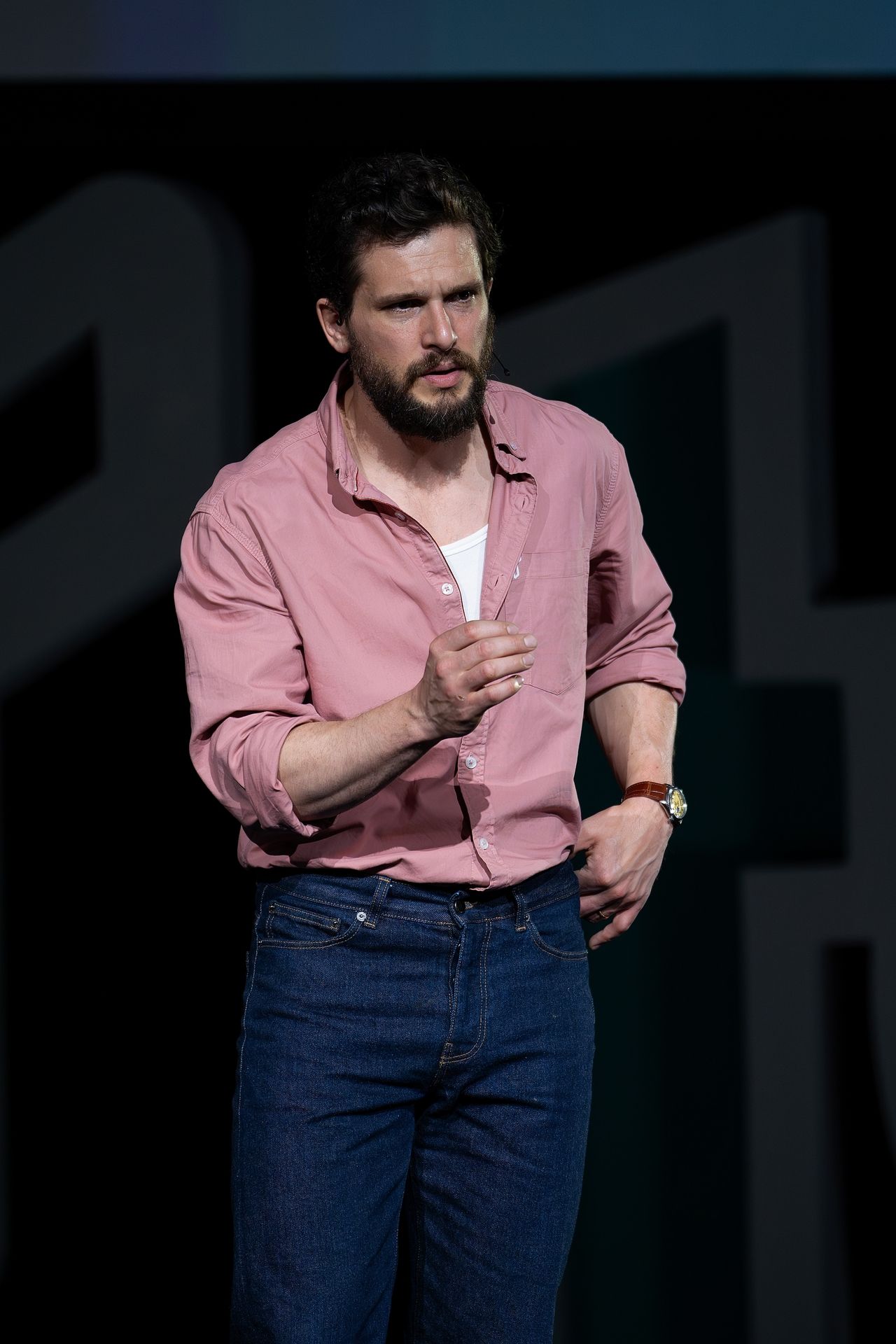
Whereas Whitney would buy something new that would be lovely—it would be an inheritance piece, but we never get quite that far with him. When we first see Whitney, everything that he’s wearing is new for a country weekend. It’s not something he’s experienced that well. He’s obeying all the elements of it. But everything he’s wearing is new, whereas everything that Henry has is much older. He’s had it.
For example, there’s a small detail in episode two of this season: Basically, he takes acid out of his old school sock, which has got his name tag on it. It was quite fun to do, because it’s those sorts of details that bring somebody to life. You talk about it with the actors, and with Mickey and Konrad, about how you can realize those tiny things in clothes, and it just changes something. It may not be something that’s immediately apparent, but it’ll turn up somewhere else, which is fun.
Oh, yeah, they will. And this is the thing: They can. It’s a kind of code that you have to understand and live and get into your bones. And sometimes there’s a polarity in it where it may never actually gel. It will always be like this, and it will never fully firm itself. I think this is the conflict between Whitney and Henry. Ostensibly, they may appear to be wearing the same type of suit, but in actuality, they’re two very different things worn in a very different way by two very different people. Henry’s shoes will be very old Church’s that he’s had resoled multiple times, whereas Whitney’s shoes will be loafers that he’s bought very recently. He may continue to change his shoes a lot—we looked at that with watches, for example, as well.
We cycled through a lot of different watches. Whereas Henry has one really great watch—he’s had other watches in other seasons, but he’s been reunited with his father’s watch in this one. That’s what he wears throughout the season.
It’s a 1974 Rolex Datejust.
He’s got a Hublot Big Bang. He’s got a Longines... a really, really lovely Longines. It’s a reissue of a 1930s style. He’s got a Tag [Heuer], an Omega. He’s got about five different watches that he cycles through.
Harper has extra watches this season. This is where she’s taken cues from her mentors. She has an Omega watch this season, Eric’s had an Omega watch. She’s taken notes and gone, “This is a thing that I can do that makes it possible for me to shake hands with this person. This is the conversation stuff, this is an opener.” She has a Cartier Tank this season as well, which is something she had last season. It was the first thing that she bought as a kind of arrival when she was working with Petra. So, she has the Tank and that’s something that she keeps this season, but then adds to it with this Omega and a Tag.
I love the show. I’ve obviously gone back and watched all of the seasons very carefully. In season one, Robert goes and gets a tailored suit. Harper’s taken a cue from the fact that this is a rite of passage that Robert’s gone through. Petra, her boss in season three, says something about, All these men in their suits who talk up a big game, and it’s all absolute nonsense. Harper realizes that there’s optics at play here that put men in that space where they can make choices in a way that Petra has to work extra hard to secure.
This is what we start season four with. She’s taken all that learning and gone, “Right, I’m going to get my clothes made.” She’s responsible in a different way. She’s a figure to be reckoned with. She can’t disappear into a group of people the way that she did in the past. In the silhouette that she comes out in, she’s undeniably a person of power in that space.
That was the point. Going back to what she’s seen with Robert and understanding that language. Otto Mostyn is the kind of person that would have a block at a tailor’s, where he would then go and get his suits made and remade, and altered over the years. He would go to maybe a couple of different tailors, and they would all hold blocks, and then they would alter them according to what was needed. Some people had off-the-peg suits and then they’d get made-to-measure. But she’s learned from being surrounded by those people that this is something that you do. It’s a matter of course. And it felt important to do that with her. There are more women’s tailors in London now than there have been at any point that cater specifically to women. She’s used her newly acquired wealth to do that, because she understands the power.
.jpg)
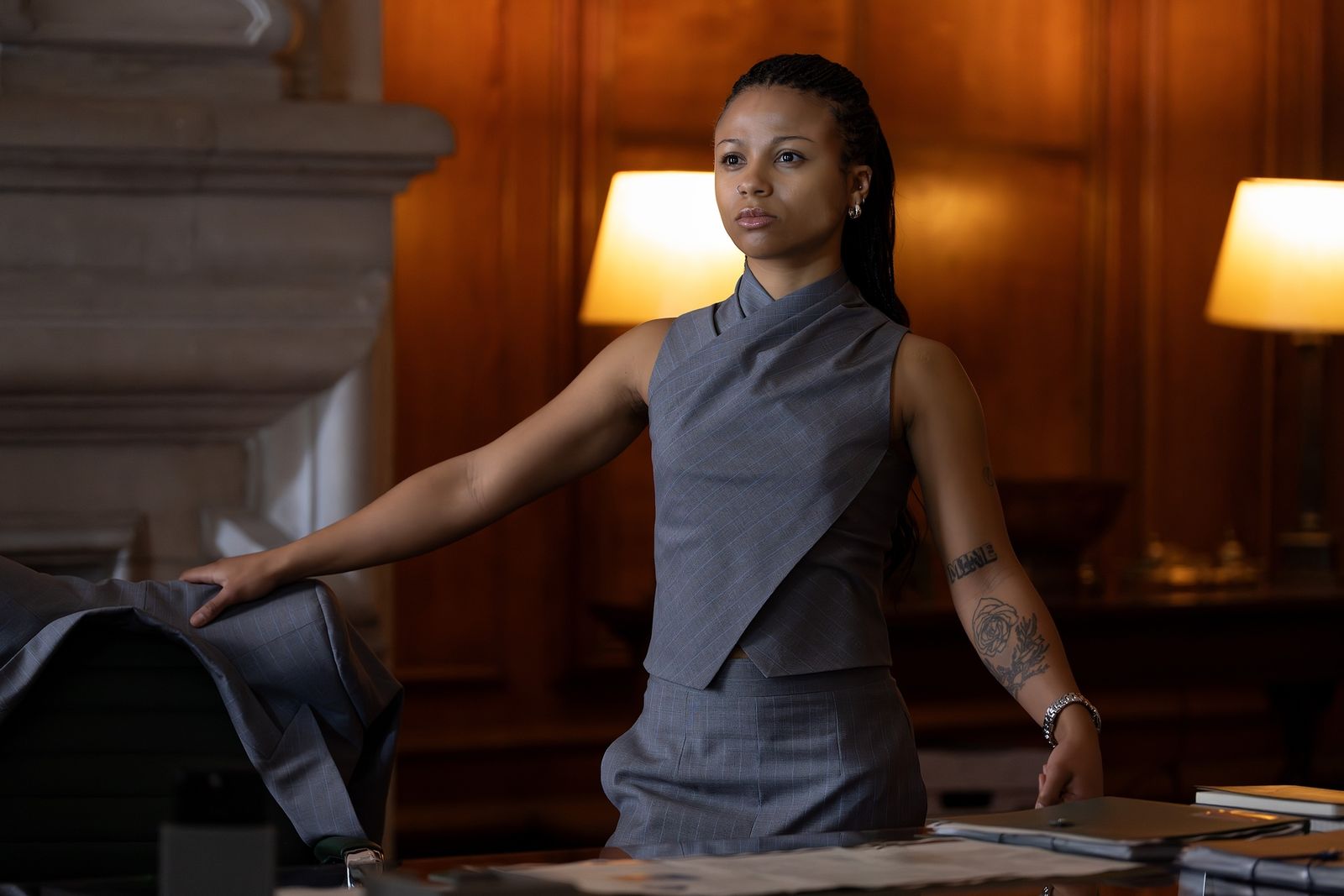
Most of them this season. The main one, her silver-gray one, is custom. The idea behind that was having something that was kind of interchangeable. I watched Working Girl, and I’ve been looking a lot at Donna Karan. She had that “Seven Easy Pieces” collection that she had as a working woman’s wardrobe. There’s body suits in the mixture with the suiting. There’s obviously a suit that she wears in episode one that we break up and take apart, and then she rewears in other spaces. It’s quite a pragmatic response. The idea being that she’s got a block like these other men have, where she will go back and get that suit tweaked. They can remake something new for her, and it will always fit her perfectly.
There was no desire for it to be masculine. I think there’s a lot of power to be had in embracing your femininity completely. Being a strong woman in that space, not trying to emulate men. There’s elements of 1940s suiting in her suit—that kind of very broad silhouette. When you look at another period of queens in the 17th century—Elizabeth I, Catherine de Medici—they all had this broad-shouldered silhouette that goes down to nothing at the waist and wide again. That was something that I thought was interesting. That’s the nice thing about the Alaïa dress that we put her in the next episode, it has that big shoulder that goes down to a tiny, tiny waist. It draws the eyes because it’s so triangulated. It’s a very strong silhouette to look at.
.jpg)
That felt just right for Harper to take up space, and to make her feel larger. Part of Harper’s charm is the fact that she can kind of beguile people into doing the things that she wants them to do. It felt important to amplify that. It was really important as well to put her in a skirt in the beginning of the first episode, because we’re so used to equating trousers to power.
One of them, it’s a small detail, but it’s in James Ashford’s hoodie. He has a hoodie that’s based on a BVI bar that doesn’t actually exist; now, the British Virgin Islands is one of the places where you’re allowed to create shell companies. [The hoodie] presents this idea that somebody’s come back from the BVI as a signatory to a company, and, as a thank you, has brought back this tourist present that James is running around the city in. It was kind of carrying on something that Mickey and Konrad liked last season, James wearing a Bear Stearns T-shirt—it’s a defunct bank. Then, this BVI hoodie.
The date on the top says 1985—that’s when the legislation came in that allowed shell companies to be set up in the BVI. It’s for the deregulation of the banking system, so that could happen. You could have shell companies where you could not track people within financial organizations. And that’s what James Ashford... I was happy that I got it.
It’s that kind of thing. If you don’t know what that is, it slips under the radar. But if you do know what that is, that’s a thing.
This interview has been edited and condensed.